
Greer City Directory Holdings
Greenville County Library System's catalog makes the historical shelf concrete. The main Greer collection record lists 1915-16, 1949, 1963 with a supplement, 1976, and annual editions from 1983 through 1997. Wing Publications, Hill Directory, and R. L. Polk appear in its contributor history. These are library-use-only archive materials, so check the catalog and request the exact edition instead of assuming a continuous run or an open online list.
| Greer collection | Verified editions | Keeper | How to use it |
|---|---|---|---|
| Greer historical directory | 1915-16; 1949; 1963; 1976; 1983-97 | Hughes Main South Carolina Collection Archive | Library use only; request the volume first. |
| Hill rural-residents series | Selected editions, 1955-82 | Hughes Main archive | Library use only; includes Greenville County rural residents. |
| Greer-Taylors Polk directory | 2000-02, 2005, 2007-25 | Hughes Main; 2022-25 also at Greer Adult Reference | Verify the cataloged edition before visiting. |
| Telephone and chamber books | 1956-95 phone runs; chamber guides 1989-90 to 2002-03 | Greenville County Library | Use as listing or civic evidence, not a complete household roll. |
| Digitized 1963 booklet | 1963 | Greer Heritage Museum | Item-level digital and archive reference. |
The gaps matter. A missing year is not a missing person. The Hill series has selected years rather than annual coverage, and its rural-residents wording can reach beyond city limits.
Note: Record the edition and page with every dated Greer finding so later checks do not turn a gap into a claim.
Greer Directory Publishers and Gaps
Different publishers made different kinds of Greer directories. The Hill Directory Company catalog record names a series that includes Greenville County rural residents, which is useful for a family near the city but not proof of municipal residence. The later Greer-Taylors Polk record identifies 2000 as a baseline and names R. L. Polk from 2001 onward. The cataloged runs should be read in sequence only where editions actually exist.
Southern Bell listings offer a separate route: Greer and Lyman covers 1956-59, while Greer/Blue Ridge volumes cover 1960-86 and 1990-95, with some two-year books. The 1976 Greater Greer telephone directory and the chamber guide or membership series add local context. A phone entry reflects service and listing choices. A chamber volume reflects participation. Neither establishes every household in Greer.
Greer Directory Research at Hughes Main
The South Carolina Room at Hughes Main is the working archive for the deepest Greer directory runs. It is at 25 Heritage Green Place in Greenville, and the library recommends appointments. Research computers, BookEye scanning, microfilm-reader download or email, staff genealogists, family files, maps, microform, newspapers, photographs, and reference books make it more than a shelf of volumes. Ask whether the requested edition is in archive storage, on microfilm, or in a database before travel.
Greer's Jean M. Smith branch is a useful first stop for a catalog check, public computers, scanning, and Book a Librarian help. Its branch information identifies it as the local access point, while the archive runs remain a Hughes Main task. This handoff avoids a wasted search for an archival volume at the neighborhood branch.
See the South Carolina Room interface used for this research at the archive's local-history page.
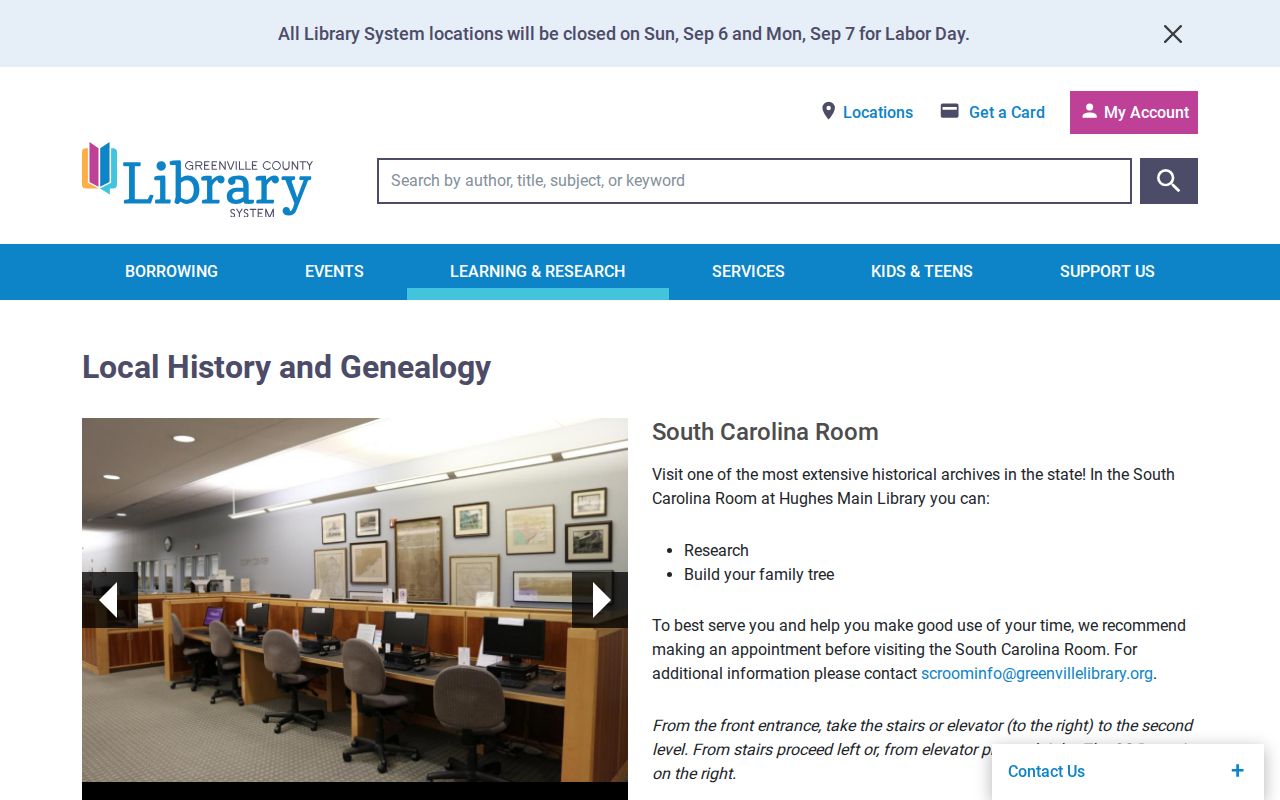
The archive route is important because a catalog result and a scan-ready reading room solve different parts of a Greer city-directory search.
Note: A staff referral is especially valuable when a directory title has changed publisher, place scope, or format between years.
Greer City Directory in 1963
The Greer Heritage Museum's 1963 directory item is the strongest digitized local example. It is accession 2023.55.1 in General Archive Box #1, Folder #8. The printed booklet includes photographs and local business and civic information, plus the directory material. Its survival gives a reader a real local volume to inspect rather than a generic description of a directory.
The same period source describes Greer as spanning Greenville and Spartanburg Counties. That detail changes the follow-up work. When an entry leads to a parcel, court, probate, or deed question, identify the relevant county first. The museum's catalog is an item-level archive route, not a promise of a complete online database.
Open the museum's 1963 directory record before requesting material from its collection.
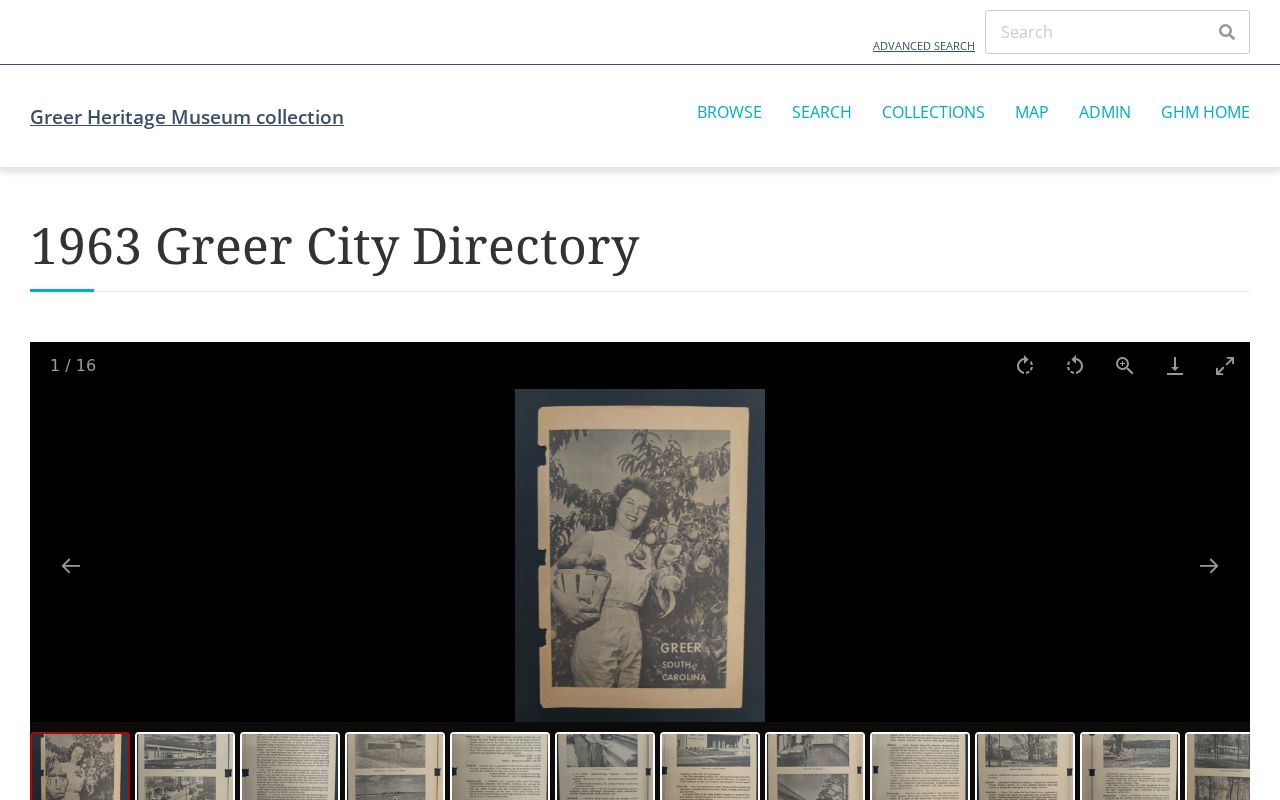
This surviving booklet is a local records story with a practical use: its street and householder material can anchor a dated address check.
The wider Heritage Museum holdings interface also helps locate related books, papers, photographs, cemetery material, and civic records.
Those associated holdings can suggest a next source, but each object needs its own date, scope, and access check.
Reading Greer City Directory Entries
A 1963 Greer directory is not one uniform list. Its alphabetical white pages can show a name, marital-status notation where supplied, occupation, street address, and adult-resident treatment. The business pages carry business name, personnel, nature of business, address, and telephone. The green pages place householders in numerical street order and may show an ownership indicator. Blue pages are numeric telephone listings. Start with the section that matches the question, then preserve the page heading and the abbreviation key in your notes.
| Alphabetical entry | Name, supplied marital notation, occupation, and street address. |
|---|---|
| Household notation | A spouse or widow reference where supplied, which should be read with the volume's key. |
| Business entry | Business name, personnel, activity, address, and telephone. |
| Green street guide | Numerical street order, householder names, and an ownership indicator where printed. |
| Blue listing | A telephone number tied to a listing, subject to service and listing coverage. |
- Criss-cross directory
- The address or street-order portion of a directory, useful for a historical block rather than a name search.
- Householder index
- A section that names the listed household contact at an address. It does not prove every occupant.
- Abbreviation key
- The volume's front-matter guide to shorthand for relationships, addresses, and listing status. Read it before interpreting a mark.
A widow notation, employer, unit, route, or owner mark can change the meaning of an entry. Do not convert a business address into a residence, and do not assume that a listed owner held recorded title without checking the appropriate county deed record.
Greer City Directory Catalog Checks
Catalog detail is part of the evidence. The main collection record states both the edition sequence and the library-use limitation. The rural-residents record states its wider geographic scope. A careful Greer city-directory request begins by choosing the title and year, then confirming where the library says it is held, rather than treating a general search result as a volume in hand.
Review the Greer city-directory catalog record before arranging a visit.
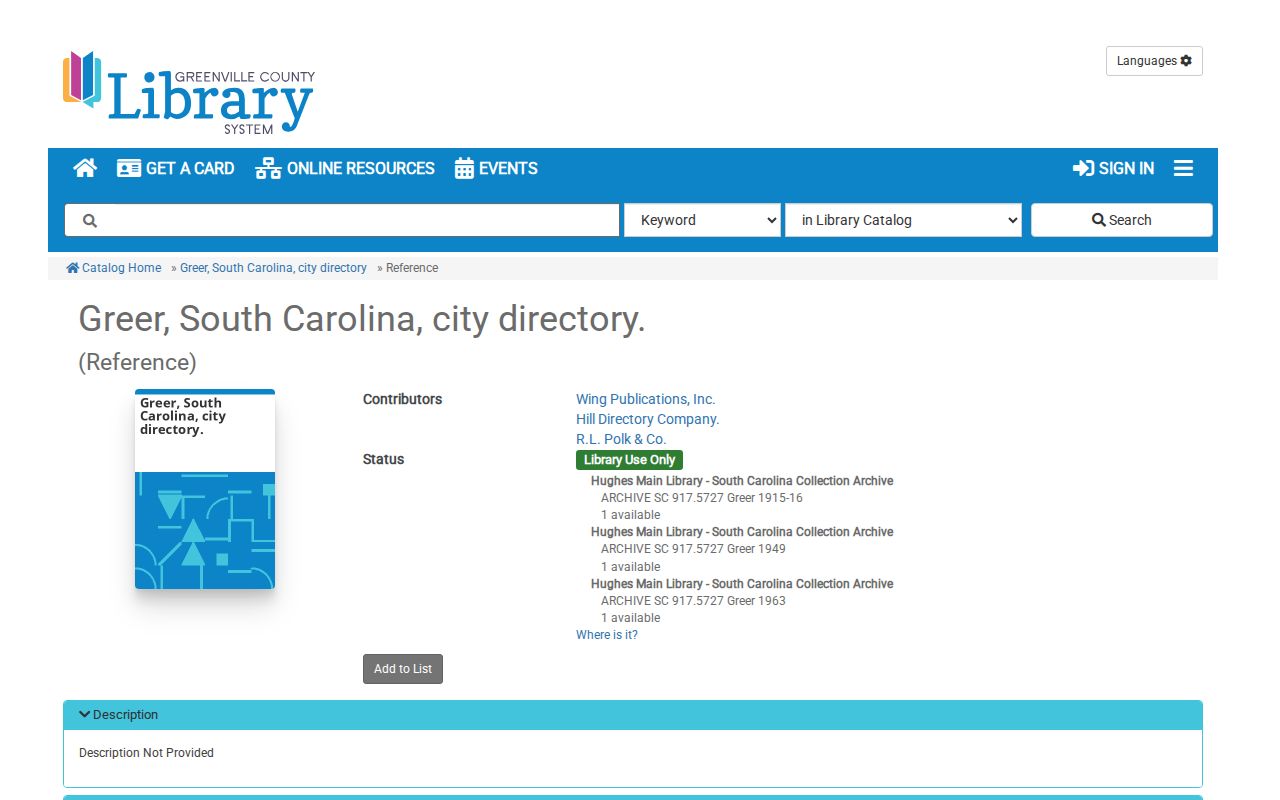
The listing supplies the edition trail, while the physical or digitized item supplies the actual page evidence.
The related Hill rural-directory catalog record deserves the same attention because its scope reaches beyond the city label.
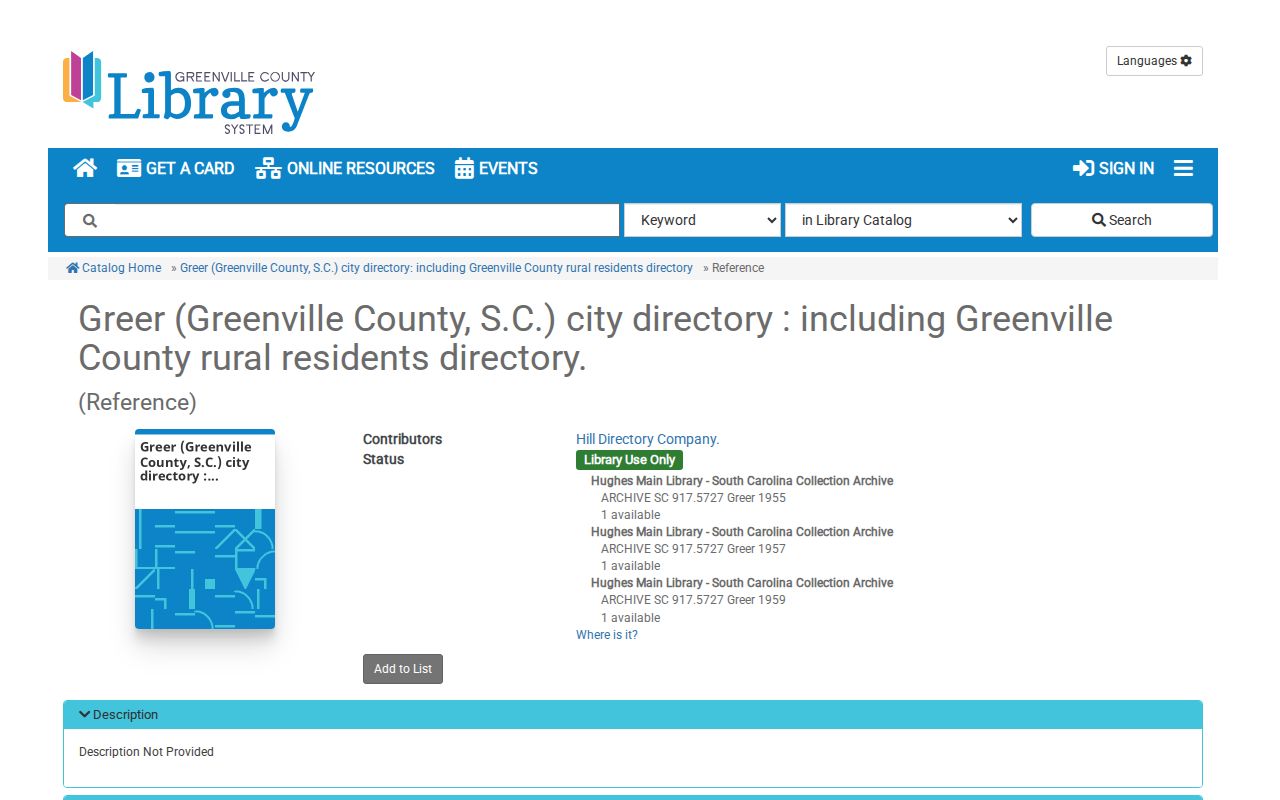
That scope warning helps prevent a rural Greenville County listing from being misread as a city-residence finding.
Greer Directories Across County Lines
Greer developed from Greer Station and the 1963 booklet describes a community across two counties. Older entries may use a mill-village, rural-route, station, rail, or industry-style description where a modern record uses a subdivision or parcel number. A Greer mailing label alone therefore does not select the deed, probate, court, voter, or assessment office. Use the City GIS county-line and city-boundary layers to orient the address, then follow the parcel to Greenville or Spartanburg records.
The record history is not a lost-record story. Greenville's documented grantor and grantee indexes and deed images reach back to 1787, while Spartanburg has older book and index routes alongside its modern online-copy ranges. A missing directory result can reflect the county, the title, the edition gap, a spelling, or the listing choices in that particular volume.
Trace Greer City Directory Households
For family history, work forward through available editions and keep the evidence dated. Start with the exact street number, spelling, and county. Locate a surname in an alphabetical section, then turn to the green street guide in that same volume. Record the edition year, page, category, spelling, address, and any spouse or occupation detail. The library genealogy resources can help staff match the format to the correct research tool.
- Find the earliest available Greer listing and note the volume's scope, not just the name.
- Move to the next cataloged edition, comparing address, spouse, occupation, and spelling before treating similar names as one person.
- Use the same edition's street-order section to see the listed household context at that address.
- Pair the dated listing with the released federal census, which follows a 72-year release schedule and currently makes 1950 and earlier public.
- For title, use the county parcel record and Register of Deeds; for a death or heir trail, use probate and an obituary or newspaper page.
A disappearance can mean a move, death, a changed listing choice, a different spelling, or simply a missing edition. A dated directory listing is a lead, not a deed, voter record, or full household census.
Greer Directory Dates and Newspapers
The Greer Citizen microfilm listing begins in 1922 and continues to the present. Pair a directory address with a nearby newspaper date for obituaries, civic notices, property notices, or local milestones, then verify the claim on the page image. A newspaper can guide a probate or deed search, but it cannot replace a vital certificate, court file, or recorded instrument.
- 1915-16: the earliest verified editions in the main Greer archive record.
- 1955-82: selected Hill rural-residents volumes add a wider Greenville County scope.
- 1963: the Heritage Museum booklet preserves alphabetical, street-guide, and telephone-listing material.
- 1983-97: annual editions appear in the cataloged main collection.
- 2000-25: selected Greer-Taylors Polk editions continue the cataloged trail, with recent copies noted at Greer Adult Reference.
The South Carolina Room's home-history approach joins property cards, deeds, directories, maps, newspapers, and census. That combination is useful when an available Greer volume gives a household listing but no answer about title, family relationship, or the exact county in which the parcel sits.
Note: Keep a separate citation for each directory page, map, deed, census image, and newspaper page because each source answers a different question.